California drivers have a broader roadside-safety responsibility in 2026. The state’s expanded Slow Down, Move Over law took effect January 1 and now applies to more stopped vehicles than many motorists may realize.
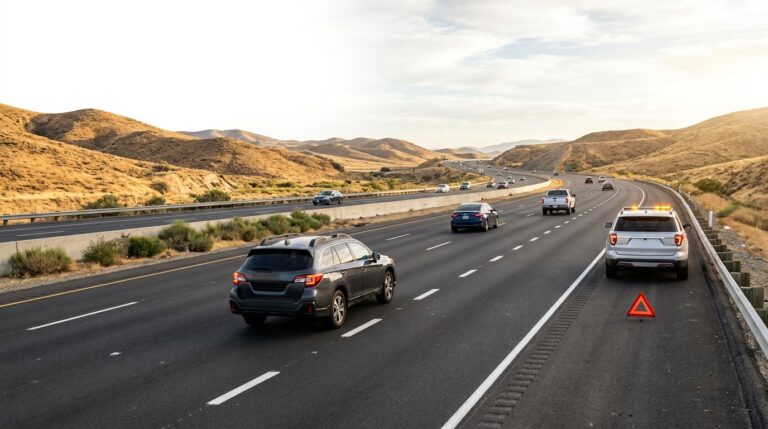
Drivers were already expected to provide additional space when approaching certain emergency vehicles and tow trucks on the roadside. Assembly Bill 390 expanded California Vehicle Code Section 21809 to include marked highway-maintenance vehicles and other stationary vehicles displaying flashing hazard lights or another warning device, including cones, flares or retroreflective devices.
That means the law can apply when the vehicle ahead is not a police car, ambulance or tow truck. A stranded motorist with hazard lights activated may also trigger the requirement.
The basic idea is straightforward: approach with caution and create additional space when safely possible. However, that does not mean making an abrupt lane change. California law recognizes that traffic, weather and surrounding road conditions may sometimes make moving over unsafe or impracticable.
Understanding the difference matters on California’s busy freeways and highways. Drivers can also review our California driving laws and driver safety guides for additional rules that affect everyday travel.
What Changed Under California’s 2026 Move Over Law?
The law now protects more stationary roadside vehicles
The important change for 2026 is the expansion of the types of stopped vehicles covered by California Vehicle Code Section 21809.
The statute continues to apply when a driver approaches a stationary authorized emergency vehicle displaying emergency lights or a stationary tow truck displaying flashing amber warning lights. It also applies to a stationary marked highway-maintenance vehicle displaying flashing amber warning lights.
AB 390 goes further by covering another category that ordinary motorists are much more likely to encounter: any other stationary vehicle displaying flashing hazard lights or another warning device.
Hazard lights, cones and flares can now matter
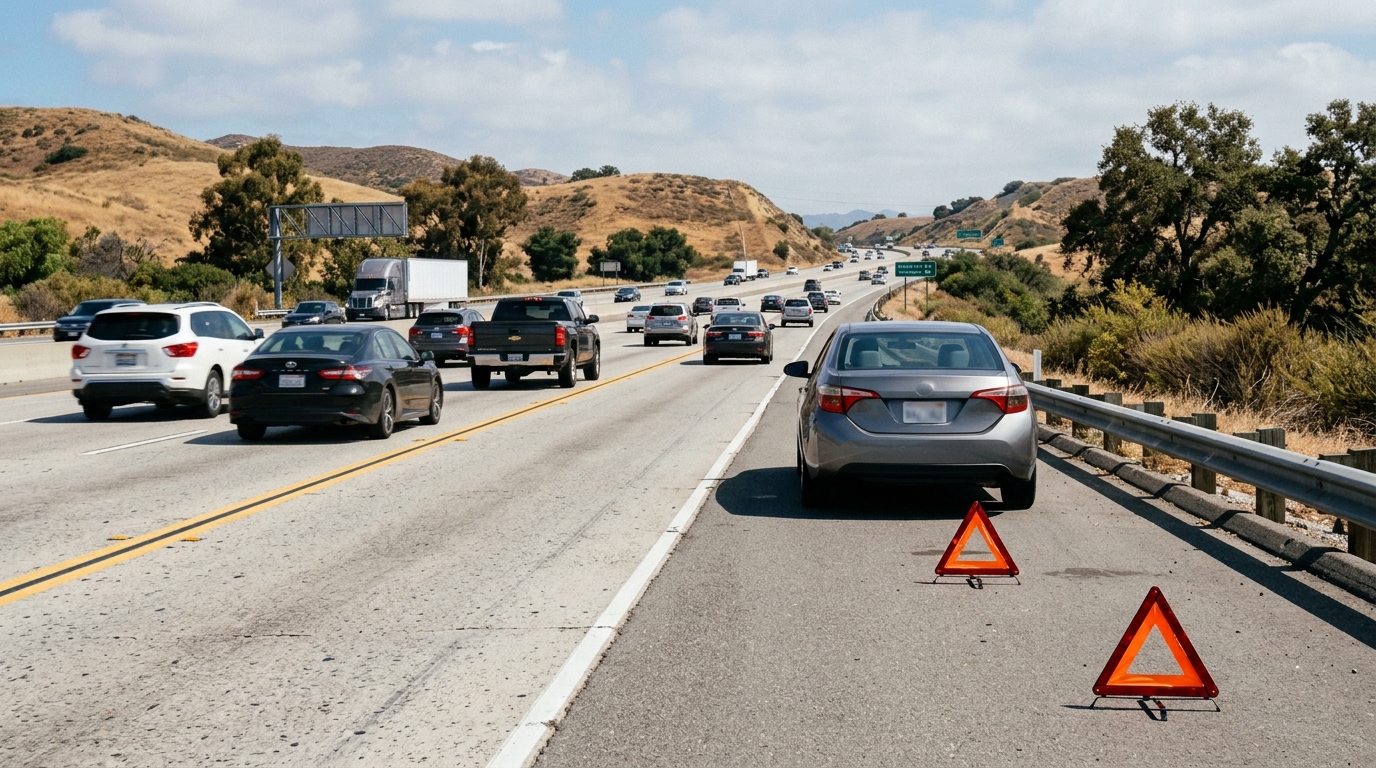
A vehicle does not need official emergency markings to receive protection under the expanded rule. The statute specifically identifies flashing hazard lights as well as other warning devices such as cones, flares and retroreflective devices.
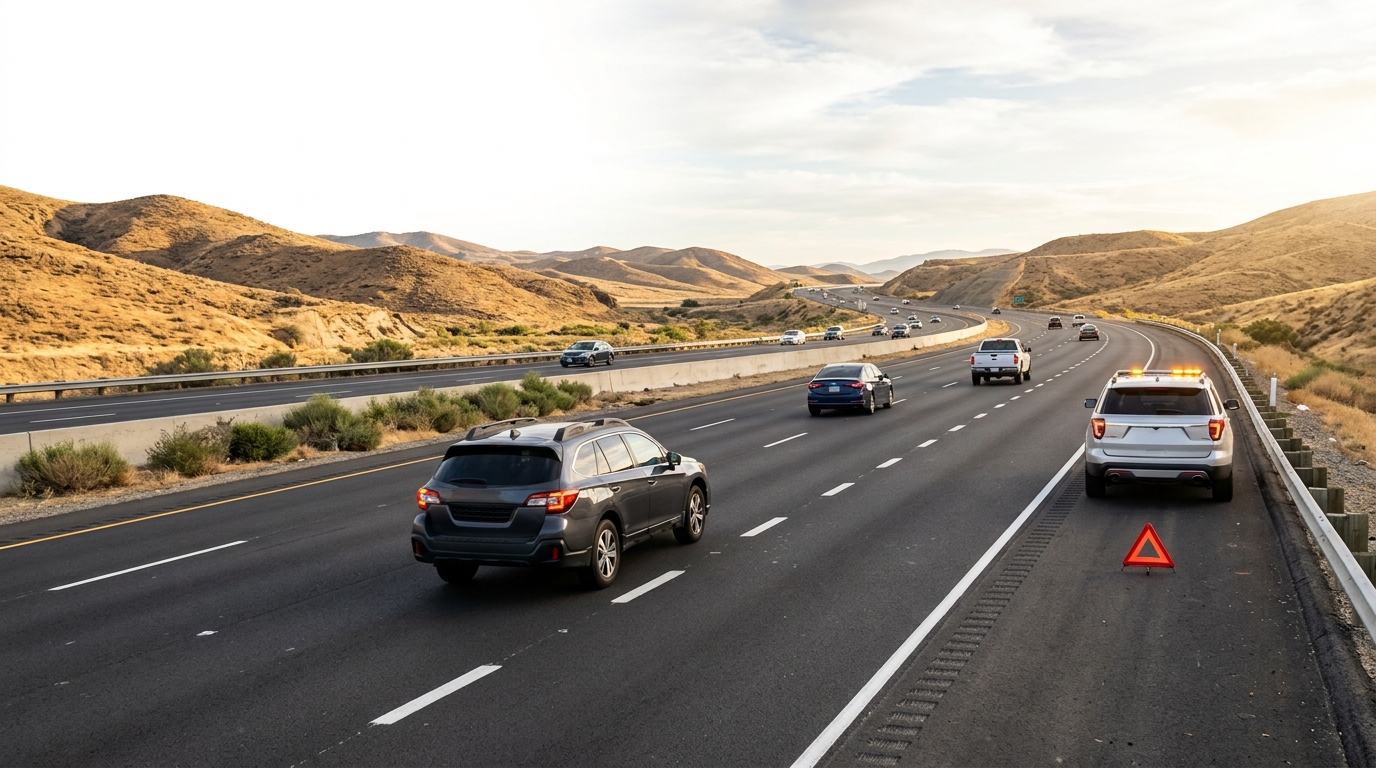
Imagine a driver suffers a flat tire on the shoulder and activates the vehicle’s hazard lights. Another driver approaching in the adjacent lane should not treat the stopped car like an ordinary object outside the travel lane. The new language requires approaching with due caution and then either moving away from the vehicle when safely practicable or reducing speed when a safe lane change cannot be made.
The change is particularly relevant for nighttime driving, bad-weather breakdowns and stretches of highway where drivers may see a stopped vehicle only shortly before reaching it.
Motorists should scan well ahead rather than waiting until they are directly beside a stranded car to react. Our California road conditions guide can also help drivers prepare for situations where weather, construction or congestion reduces reaction time.
Marked highway-maintenance vehicles also receive broader protection
AB 390 also expanded the law from its previous focus on certain Caltrans vehicles to marked highway-maintenance vehicles more generally.
Under the statute, a highway-maintenance vehicle can include a vehicle used to maintain California highways or roadways that is operated by Caltrans, a county, a municipality or another political subdivision. It can also include qualifying vehicles operated by contractors working under contract with those public agencies.
This matters because motorists routinely encounter crews repairing pavement, maintaining roadside infrastructure, clearing debris or performing other work near moving traffic.
A worker standing only a few feet from highway-speed traffic has little protection from a driver who drifts toward the shoulder. Creating additional separation between traffic and a stationary maintenance vehicle can give both workers and motorists a larger safety margin.
Moving over does not mean making an unsafe lane change
Some motorists hear “move over” and assume they must change lanes immediately regardless of traffic. That is not what California Vehicle Code Section 21809 requires.
When approaching a covered stationary vehicle, drivers must approach with due caution. Before passing in the lane immediately adjacent to that vehicle, the driver should move into an available lane that is not immediately adjacent when doing so is practicable, lawful and consistent with safety and traffic conditions.
Make the lane change early when it is safe
The safest response usually begins well before reaching the stopped vehicle. Check traffic ahead, identify the warning lights or roadside activity, look in the mirrors, check the adjacent lane and signal before changing lanes.
A gradual lane change gives surrounding drivers more time to respond. An abrupt movement at the last second can create another hazard, especially when vehicles are traveling at freeway speeds.
Drivers should not force themselves into a lane that does not have a safe opening. They should also avoid cutting off another motorist simply to comply with the move-over portion of the law.
The statute specifically qualifies the lane-change requirement by safety, traffic conditions and whether the maneuver is practicable. Normal lane-change rules still matter.
This is particularly important for drivers traveling through congested areas in Los Angeles, the Bay Area, Sacramento, San Diego and other high-traffic regions where an adjacent lane may already be full.
If moving over is unsafe, slow to a reasonable and prudent speed
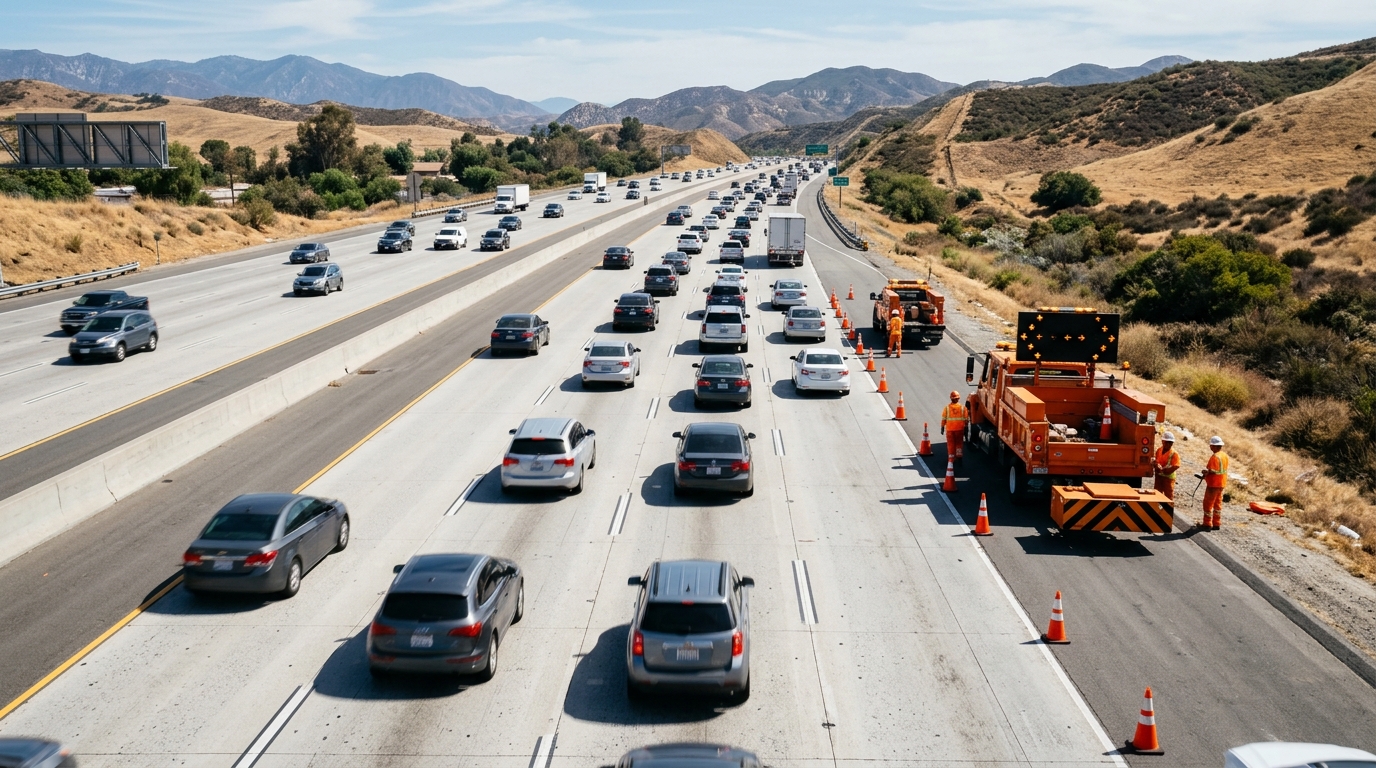
California law provides an alternative when changing lanes would be unsafe or impracticable. The driver should slow to a reasonable and prudent speed that is safe for the existing weather, roadway, vehicle and pedestrian conditions.
The statute does not establish one universal reduced speed for every roadside situation. That makes sense because passing a stranded vehicle on an empty, dry highway is different from approaching one during rain, darkness, heavy congestion or limited visibility.
Drivers should reduce speed early and smoothly rather than braking aggressively when they are already alongside the stopped vehicle. Leave additional following distance so that slowing does not surprise the vehicle behind you.
California Vehicle Code Section 21809 currently makes a violation an infraction punishable by a statutory fine of up to $50. Drivers should remember, however, that avoiding a citation is not the main purpose of the rule. The larger goal is preventing roadside collisions involving stranded motorists, emergency responders, tow operators and highway workers.
How California Drivers Should Handle Roadside Vehicles
Use a simple safety routine whenever you see roadside warning lights
The expanded law gives California drivers a useful habit to follow: see the warning, evaluate surrounding traffic, create space if possible and reduce speed when necessary.
Start scanning ahead whenever you notice hazard lights, amber warning lights, emergency lights, flares, cones or another sign that a vehicle is stationary beside the roadway. Avoid staring directly at the incident. Drivers sometimes unconsciously steer toward whatever they are watching, and roadside activity can become a distraction.
If another lane is safely available, signal and move over before reaching the stopped vehicle. Do not wait until the last possible moment.
If traffic prevents a safe lane change, maintain control of your lane and reduce speed to a level appropriate for the situation. Be prepared for pedestrians, workers, tow operators or vehicle occupants near the shoulder.
Drivers should be especially cautious at night. A dark-colored disabled vehicle may be difficult to see until its hazard lights become visible. Rain, fog, smoke and curves can reduce that distance even further.
The same principle applies during a California road trip. Rural highways may have lighter traffic, but motorists can encounter disabled vehicles in locations with narrow shoulders, limited cellular service or long distances between roadside-assistance providers.
Rural highways
If your own vehicle becomes disabled, move as far from active traffic as safely possible when circumstances allow. Activate the hazard lights and use appropriate warning devices if they can be deployed without putting yourself in danger. Avoid standing in or immediately next to a live traffic lane.
You can also explore our California towing and roadside assistance directory and vehicle maintenance guides for resources related to breakdown preparation and vehicle care.
There is an important exception to understand as well. Section 21809 states that its requirements do not apply when the stationary vehicle is not adjacent to the highway or when a protective physical barrier separates it from the highway. Drivers should still operate cautiously whenever roadside conditions create a potential hazard.
The expanded 2026 law ultimately makes the roadside rule easier to understand: warning lights are a reason to pay attention even when the stopped vehicle is an ordinary passenger car.
When there is a safe lane available, create more distance. When moving over would create another hazard, slow appropriately and pass with care. A few seconds of added caution can provide substantially more protection to someone dealing with a breakdown or working beside fast-moving traffic.
For the exact legal requirements, review California Vehicle Code Section 21809 on the California Legislature’s official website.